
When people ask me what I do, what I offer is often very quickly reformulated: “Oh, so you help people with their problems.” Each time, something in me freezes. Not a clear opposition, but rather a form of dissonance, a quiet misunderstanding. I find myself wondering what is really at play: is it a way of simplifying, of reassuring oneself, a projection, or a refusal to look at what escapes familiar categories?
It took me time to find the right word, the one that does not seek to reduce or explain too quickly, but simply to clarify. Today, I have found the formulation that makes sense to me: I accompany women through life passages.
There are moments that call for neither solutions, nor methods, nor processes, nor objectives, nor transformation. Moments when life does not ask to be understood, but to be crossed. Not because it is obscure or absurd, but because it unfolds on another register altogether, more raw, more fluid, less governable.
A passage is not a project one manages. It is not a clearly marked before and after. It is not a promise of outcome. It is an in-between, often unforeseen, in which one finds oneself carried by a river already in motion, without immediately realizing that the crossing had already begun.
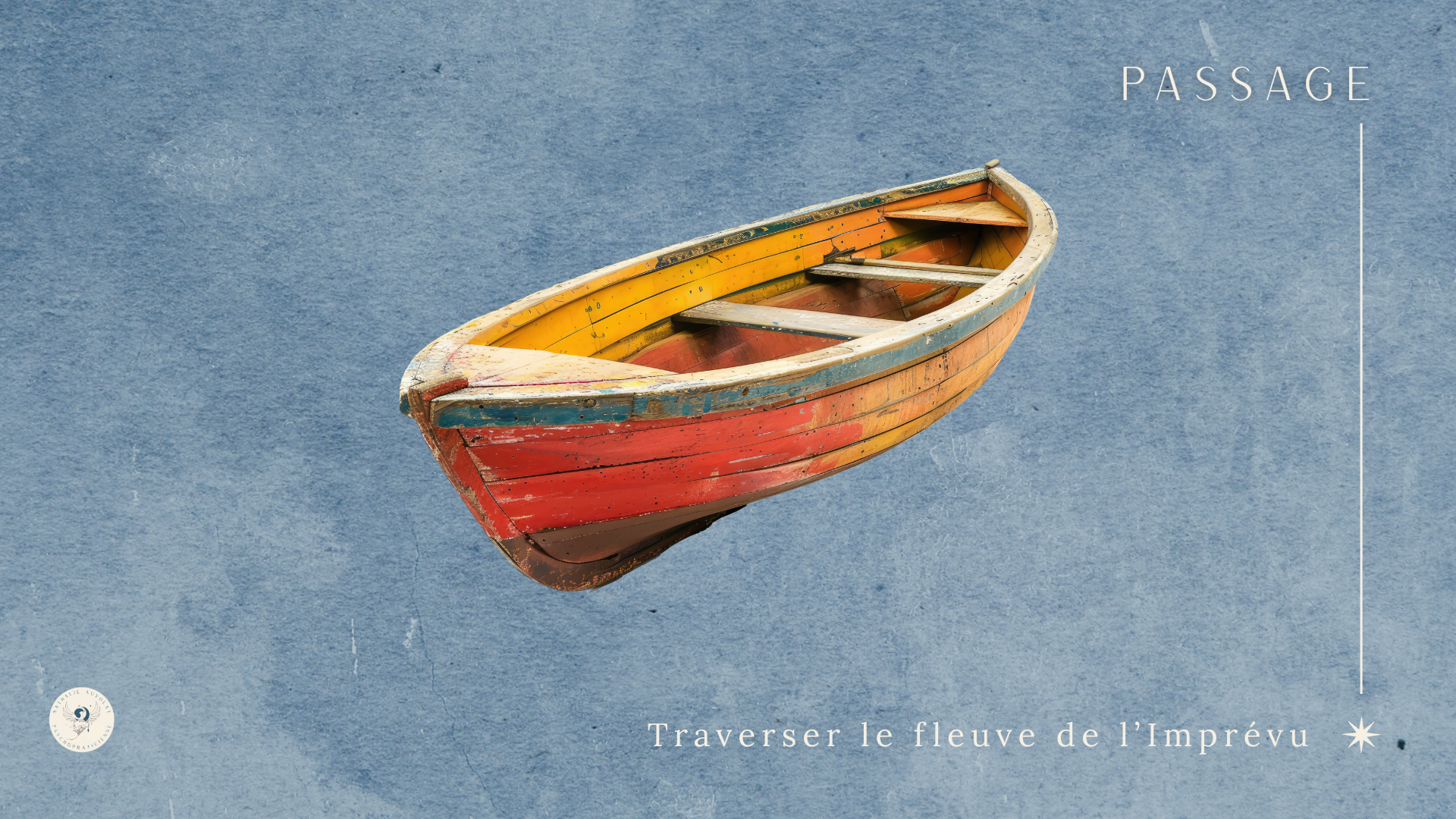
The current is there. Life imposes itself. We no longer control it in the same way. And sometimes, in those moments, all that is possible, all that is truly supportive, is not to be alone in the boat.
I. When the word “problem” fails to speak to lived experience
Speaking of a “problem” is often a quick, and most often unconscious, way of naming what a woman might be going through, without fully measuring the real impact such a word can have.
The word “problem” carries something reassuring, distancing, almost practical. It presumes an identifiable cause, a circumscribed difficulty, and somewhere, a solution to be found. It installs the idea that what is being lived is a temporary and individual dysfunction, calling for repair, correction, a return to balance.
In some situations, this reading may be relevant. But there are moments in life that radically escape this logic. Moments in which what is unfolding is not a problem to be solved, but a deep displacement of being, a loss of bearings that cannot be approached as a simple obstacle on a path imagined as already laid out.
To speak of a problem in such passages often reduces the lived experience. Not out of ill intent, but because the word has no room for what is blurred, unstable, still unformed. It closes too quickly what is, in reality, in the process of coming undone, without yet knowing what might, or might not, take shape again.
This way of naming things often reassures those around. It gives the impression that the situation is contained, that it can be understood from the outside, that it will eventually resolve itself. It also allows, at times, a certain distance from what unsettles us, from what calls into question our own certainties about continuity, meaning, and the control we believe we have.
But for the one who is crossing, this reformulation can become an additional experience of isolation, even of unintentional judgment. Because what she is living is not necessarily repairable. It is not always about getting better, nor even about understanding what is happening. Sometimes it is about remaining present while something collapses, while former identities, roles, and inner reference points cease to function as before.
In those moments, ordinary language lacks substance. It slides past the real experience. It leaves no space for the in-between, for that uncertain zone where one no longer knows what is dying nor what might be born. It allows neither duration, nor slowness, nor the disorientation that so often accompanies such passages.

II. Passage as a fundamental human experience
We are brought, at times, to confront a loss of bearings: the old world stops working, first in imperceptible ways, then more loudly. What once provided reference points — roles, certainties, ways of defining ourselves and projecting forward — gradually loses its relevance or its meaning. Nothing has yet fully collapsed, and yet something no longer holds. Familiar gestures become hesitant, words fail us, and known frameworks no longer offer the support they once promised.
In these passages, it is not only an external situation that changes, but the very way we inhabit our lives. Reference points fall away, not always noisily. There is not yet an intelligible narrative, no global understanding, no stabilized meaning to lean on. What is being lived is often diffuse, difficult to name, and this is precisely what makes the experience so disorienting.
These moments can take many forms. They may be woven through visible or invisible losses, identity shifts, bodily transformations, relationships that unravel, move, or disappear. At times, they manifest as a formless inner call, a persistent sense of dissonance, a feeling of no longer being able to continue as before, without yet knowing how to do otherwise.
What characterizes these passages is not so much their content as their quality. They suspend what once seemed obvious. They undo overly coherent narratives. They place us in a particular time, where we move without a map, without guarantees, often without adequate language. A time in which one can neither go back nor truly project oneself forward.
Passage is a fundamental human experience because it touches that fragile zone where identity reshapes itself without our mastering the process. It lays bare our relationship to time, to loss, to uncertainty. And it reminds us, sometimes painfully, that life does not always unfold according to the scenarios we had imagined.
III. Speaking of passage differently: the metaphor of the river
The word “transformation” is everywhere in contemporary narratives. It suggests a marked passage, oriented toward an expected betterment, tinged with a will toward ascent. It presumes that one state gives way to another, that a before leads to an after that is clearer, more aligned, more accomplished. Transformation tells a readable, often desirable trajectory, in which change is presented as a process that can be understood, accompanied, and, to a certain extent, controlled.
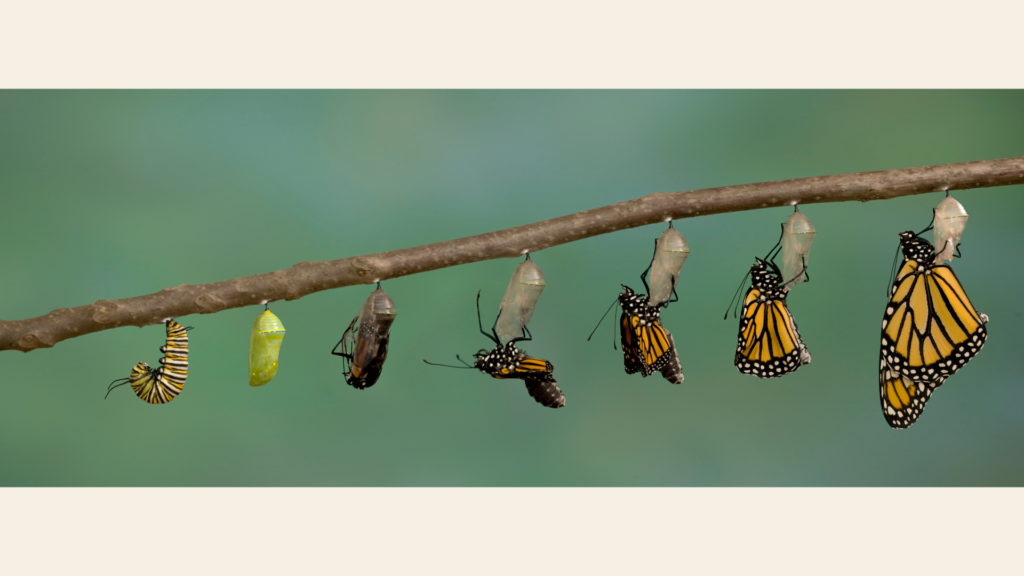
Yet this way of speaking does not always correspond to lived experience. In many life passages, nothing transforms in a clear or linear way. There is no immediately identifiable new form, no coherent story to produce, no obvious direction toward which to move. What is being lived is indeed a metamorphosis, but one that unfolds slowly, in darkness and apparent stillness, like the time of the chrysalis — a crossing whose rhythm and contours cannot be controlled.
The metaphor of the river allows this to be expressed more accurately. A river does not obey a logic of progress. It flows. It sometimes overflows. It slows down, widens, narrows, changes its bed. Its movement is neither constant nor predictable, and yet it is real. We do not impose direction upon it, we do not negotiate its course, we do not decide when it accelerates or calms.
In a life passage, time often behaves in much the same way. It no longer follows familiar markers. It stretches, contracts, becomes troubled. What was expected does not arrive; what was unforeseen asserts itself. The experience does not ask to be optimized, but to be crossed, with all the uncertainty, fatigue, and sometimes loss that it carries.
Speaking of a river rather than transformation is a way of acknowledging this loss of control. It is a way of accepting that certain movements of life do not immediately lead to a more stable or luminous form. It is also a way of stepping out of an implicit injunction to get better, to understand, to extract a lesson, while the experience is still unfolding.
The river teaches nothing while one is immersed in it. It offers no clear message. It asks that we remain present, that we adjust our posture, that we hold ourselves within the movement. And sometimes, that is already enough.
IV. Accompanying a life passage: what it is not
Accompanying a passage often begins with a renunciation: the renunciation of wanting to repair, correct, or accelerate what is being lived. In such moments, any premature attempt to restore order risks producing the opposite effect, adding pressure where fragility already exists, and turning the experience into a presumed failure when it does not progress as expected.
Accompanying a passage does not consist in intervening to relieve, correct, or hasten what is unfolding. Nor does it mean offering a method, a series of steps, or a marked path toward a reassuring exit. Life passages do not obey a logic of rapid resolution, and forcing them into an operational framework can become a subtle form of violence, often well-intentioned, but deeply misaligned.
It is not about providing answers, nor about producing meaning on behalf of the one who is crossing. There are moments when meaning has not yet taken form, and forcing it closes an experience that still needs time to unfold. Promising a better shore, a luminous outcome, or a beneficial transformation can sometimes amount to denying the reality of the present moment.
Accompanying a passage is not about guiding, pulling, or pushing. It is not about walking ahead to show the way, nor standing behind to urge movement. It is about accepting to walk side by side, at a rhythm that is not one’s own, without knowing exactly where it leads.
In this posture, it is not a matter of making discomfort disappear, nor of neutralizing uncertainty. It is about recognizing what is there, as it is, without trying to optimize it. About holding a space stable enough for what is coming undone to continue undoing itself, without interruption or judgment.
To name what accompaniment is not is already to draw a boundary. A boundary that protects against doing too much, understanding too much, wanting too much. A boundary that allows for an attuned presence, respectful of the time a passage requires, and of the singularity of the one who is crossing it.
V. Not being alone in the boat
There comes a moment when one understands that there is nothing more to do. Nothing to resolve, nothing to improve, nothing to anticipate. The passage is there, whole and demanding. It does not call for a prescribed heroism, shaped and validated by the external gaze. It calls for a different kind of courage, more interior, more discreet, often invisible.
In such moments, solitude can become crushing. Not because no one is around, but because what is being lived no longer finds resonance in familiar words. Those around may want to help, reassure, encourage, sometimes repair. But what is at stake here unfolds on another level.
Not being alone in the boat does not mean being rescued from the current. Nor does it mean being protected from discomfort or uncertainty. It means being able to remain present with what is being lived, without having to justify it, make it coherent, or acceptable.
The boat is not a promise of arrival. It is not a shortcut. It does not prevent fatigue, fear, or doubt. It allows one thing only: not to sink into inner isolation while the river continues its course.
Sometimes, being accompanied changes nothing about what is happening. And yet, it changes everything. It changes the way one crosses, the way one holds, the way one remains alive in the in-between.
There are passages where nothing more can be done. Passages where the only possible thing, the only thing that truly supports, is not to be alone in the boat.